



The Botanical Archive
JUNIPER
THE BOTANICAL THAT DEFINES GIN
Without juniper there is no gin. For thousands of years Juniperus communis has shaped flavour, medicine, trade and landscapes across Europe. Today this remarkable native shrub is disappearing from the English countryside, making its future more important than ever.
JUNIPERUS COMMUNIS
BOTANICAL PROFILE
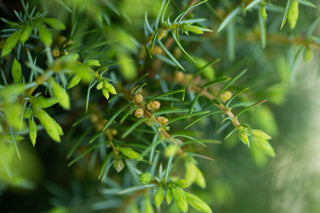
Juniper is one of only three conifers native to Britain. Found on chalk downs, limestone grassland, heath land and exposed hillsides, it is a slow-growing evergreen capable of surviving for centuries. Female plants produce the aromatic berry-like cones used in gin, while male plants release clouds of pollen each spring.
Each bottle starts with around 65 hand-selected juniper berries, providing the resinous pine and citrus character that forms the backbone of every gin we produce.

NATIVE SPECIES
One of Britain's three native conifers. Sadly 80% has been lost in the countryside.

SLOW GROWING
Seed cones take from 18 months up to 3 years to fully ripen.

DIOECIOUS NATURE
Junipers are dioecious, meaning individual trees are strictly male or female.

LONG LIVED
Juniper can live for 400 years and one plant is dated to be over 1,600 years old.
WHAT DOES JUNIPER TASTE LIKE?
FLAVOUR AND AROMA
Juniper provides gin's unmistakable identity. Pine, citrus, resin, pepper and subtle floral notes combine to create a flavour profile that no other botanical can replicate. The exact character varies depending on climate, soil and harvest conditions.
The most dominant oil is alpha-pinene, responsible for the classic fresh pine and resinous notes that define gin. Limonene adds bright citrus undertones, while myrcene contributes subtle earthy and peppery hints. Sabinene introduces a spicy, woody character, enhancing depth, while terpineol brings delicate floral and herbal qualities.

PINE
Fresh woodland and evergreen notes.

CITRUS
Bright grapefruit and lemon character.

SPICE
Pepper, warmth and gentle heat.

RESIN
Undertones of rosemary and woody spices.

The Botanical That Built Gin
WITHOUT JUNIPER THERE IS NO GIN
European distillers have relied on Juniperus communis for centuries. Regulations still require juniper to remain the dominant flavour in any spirit described as gin. Every bottle begins with this remarkable berry.
A THREE-YEAR JOURNEY
FROM FLOWER TO BERRY
Unlike most fruits, juniper berries demand patience. What we call a berry is actually a fleshy seed cone, and it can take up to three years to fully mature. Throughout that time the plant supports pollinators, wildlife and countless species before finally producing the aromatic berries prized by distillers.
Every juniper berry used in gin represents years of growth, exposure to the elements and careful development. Few botanicals require such patience, which makes every harvest a reminder of nature's timescale rather than our own.

Pollination
YEAR 1
In early spring, male juniper plants release clouds of yellow pollen. Carried by the wind, it reaches nearby female plants and begins the slow process of berry formation. Tiny green cones appear.

Growth & Development
YEAR 2
The immature berries remain firm and green as they slowly develop essential oils, sugars and flavour compounds. During this stage they are bitter and lack the characteristic aroma associated with gin.

Ripening
YEAR 3
As maturity approaches, the berries darken from green to deep blue-black and develop a waxy bloom. Resinous, citrus and pine aromas intensify, creating the complex flavour profile sought by distillers.

Ready For Distillation
HARVEST
Harvested during autumn, ripe berries are carefully collected and dried to preserve their essential oils. It is these mature berries that provide gin with its unmistakable character, structure and identity.
MORE THAN A GIN BOTANICAL
WILDLIFE VALUE
Juniper supports far more than gin. These slow-growing shrubs provide food, shelter and breeding habitat for a wide range of wildlife. Their evergreen branches offer year-round protection, while their berries sustain birds and mammals through the winter months.
Healthy juniper stands support specialist insects, lichens and fungi, with birds helping disperse seeds across the landscape. On southern England's chalk grasslands, juniper forms part of a rich habitat mosaic that benefits pollinators, reptiles, farmland birds and wildflowers.
Protecting juniper means protecting the wider ecosystem that depends upon it. Every new grove strengthens biodiversity and helps secure the future of this iconic native species.

Winter Refuge
PROTECTION
Dense evergreen foliage provides year-round cover for birds, small mammals and insects. During harsh winters, juniper offers vital protection from predators, wind and rain.

Natural Food Source
FOOD FOR WILDLIFE
Its berry-like cones provide an important food source for thrushes, field fares, waxwings and other wildlife during autumn and winter when food becomes scarce.

Hidden Biodiversity
A LIVING HABITAT
40 species of fungi are entirely or partially dependent on juniper, living on its dead wood or root systems. It supports specialist insects and lichens. Creating a rich ecosystem within every grove.

Landscape Recovery
REGENERATION
Birds feed on juniper berries and disperse seeds across the countryside, helping establish new plants and strengthening biodiversity for future generations.
The Challenge
WHY IS JUNIPER DISAPPEARING
Juniper is declining due to habitat loss.
Once widespread across the UK and Europe, juniper populations have declined significantly, with nearly 50% of its historic range lost and some regions seeing up to a 70% reduction in Wiltshire.
THE CAUSES
Factors such as overgrazing, grove collapse, disease, and land mismanagement have made it difficult for young juniper plants to establish and thrive. Additionally, poor seed viability has led to aging populations with little natural regeneration, making long-term survival uncertain.
Climate change is another major challenge. Warmer temperatures and drier conditions disrupt the delicate balance needed for germination and growth, while an increase in fungal diseases like Phytophthora austrocedri further threatens its survival. Since juniper berries take two to three years to mature, any disruption in growth cycles will impact its micro eco system.
REWILDING JUNIPER
HELPING THE COME BACK.
Juniper thrives on dry, chalk-rich soils and sunny south-facing slopes. Hardy, drought-tolerant and perfectly adapted to the Wiltshire Downs, it once formed a familiar part of the local landscape.
When Downton Distillery relocated to Domaine Hugo Vineyard, we saw an opportunity to help reverse its decline. Our original plan was to grow juniper from seed, but with germination taking up to three years and browsing pressure from deer and hares, progress would have been slow and uncertain.
Instead, proceeds from Explorer's Gin and customer donations funded the purchase of 50 juniper saplings in 2022. These were planted across two groves and carefully nurtured on the vineyard. In January 2025, the first grove was successfully rewilded onto the Wiltshire Downs, while the second continues to thrive overlooking Wick Down.
Today, a third grove is being established beside the distillery as we continue our commitment to restoring juniper to the local landscape.
We are grateful to the Great Bustard Group for their support and expertise throughout the project.
If you own land on the Wiltshire Downs and would like to help establish future juniper groves, we'd love to hear from you.
CHALLENGES WE HAVE FACED
Juniper doesn’t come cheap young saplings start at £13, while mature plants can sell for over £1,000! Adding to the challenge, sourcing juniper is difficult due to limited availability and slow growth, making it a prized yet hard-to-find plant.
Growing juniper comes with unique challenges, as these hardy plants face constant threats from both wildlife and the elements. Deer and hares frequently strip bark and nibble young saplings, weakening or even killing the plants before they can mature. Strong winds can snap fragile branches, particularly in exposed areas, while freezing temperatures can stunt growth, damage developing berries and cause browning. Bindweed poses another challenge, aggressively twining around saplings, blocking sunlight, and suffocating young plants. Die back where the juniper suddenly browns and dies can also strike unexpectedly. This is something we have seen with devastating consequences.
These factors make juniper restoration and rewilding a slow and delicate process, requiring protective measures, careful site selection, and long-term management to ensure successful growth.


