


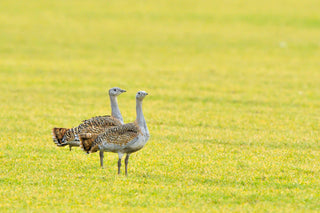
THE RETURN OF A GIANT
THE GREAT BUSTARD
Once extinct in Britain, the Great Bustard is slowly returning to the Wiltshire Downs through one of the world's most ambitious bird reintroduction programmes. Through our partnership with the Great Bustard Group, every bottle helps support the future of this remarkable species.
EXTINCT IN 1832
A BIRD LOST TO BRITAIN
The Great Bustard (Otis tarda) has existed for hundreds of thousands of years, with fossil records in Europe dating back more than 350,000 years. For centuries, this giant bird roamed the open grasslands and chalk downs of southern England. Standing over a metre tall and weighing up to 20 kilograms, it was one of Britain's most impressive native species.
However, changing farming practices, habitat loss and hunting pushed the Great Bustard into decline. By 1832, it had become extinct in Britain. For more than 160 years, the bird survived only in paintings, museum collections and local folklore. Today, thanks to the efforts of the Great Bustard Group and its supporters, this remarkable species is once again returning to the Wiltshire Downs.
Extinct in Britain: 1832 | Height: Up to 1.2 metres | Weight: Up to 20kg | Wingspan: Up to 2.4 metres.
THE COMEBACK
ONE OF THE WORLD'S MOST AMBITIOUS REINTRODUCTIONS.
For more than 160 years, the Great Bustard was absent from Britain. Many believed it would never return. Yet in 1998, conservationist David Waters founded the Great Bustard Group with a bold ambition: to restore this iconic bird to the landscape it once called home.
Working alongside international partners, landowners, farmers and volunteers, the project began reintroducing birds to Salisbury Plain. Progress has been gradual and challenges remain, but the results are remarkable. Today, Great Bustards once again roam the Wiltshire Downs, making this one of the most successful and ambitious bird reintroduction programmes in the world.
BRITAIN'S HEAVIEST FLYING BIRD
MEET THE BIRD.
The Great Bustard is one of the world's most extraordinary birds. Males can weigh as much as 24 kilograms, making them the heaviest flying bird found in Britain. Yet beyond its size lies a fascinating story of courtship displays, remarkable adaptations and a life shaped by the open grasslands of Salisbury Plain in Wiltshire.

THE GIANT OF THE SKIES
MALE GREAT BUSTARD
Standing over a metre tall and weighing up to 20 kilograms, the male Great Bustard is Britain's heaviest flying bird. Its distinctive white whiskers, rich russet plumage and imposing size make it instantly recognisable. During courtship displays, males puff out their feathers and turn brilliant white in one of the most extraordinary spectacles in the natural world.

THE NEXT GENERATION
FEMALE & CHICKS
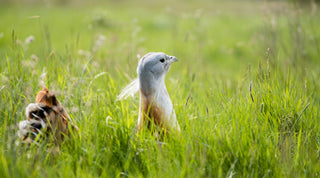
Smaller and perfectly adapted to life on the ground, the female Great Bustard relies on her camouflaged plumage to remain hidden amongst grasses and crops. She raises her chicks alone, protecting and guiding them through their earliest days. Within hours of hatching, young birds are already exploring the landscape and learning the skills needed to survive.

NATURE'S GREATEST SHOW
THE LEK DISPLAY
Each spring, male Great Bustards gather on traditional display grounds known as leks, where they compete for the attention of females. By inverting their wing feathers they turn themselves almost completely white, they create one of nature's most remarkable spectacles. These displays can continue for hours and are a defining feature of life on Salisbury Plain.

LIFE ON SALISBURY PLAIN
BUILT FOR THE DOWNS
Great Bustards prefer open landscapes, allowing them to detect predators from a distance. Though heavy, they are strong fliers quickly taking to the sky. Their diet changes throughout the year and includes insects, seeds, lucerne, clover and rocket. At night they sleep on the ground, because they lack a scent-producing oil gland, they remain surprisingly difficult for foxes to find.
CONSERVATION IN ACTION
RESTORING MORE THAN A SPECIES.
Returning the Great Bustard to Britain involves far more than releasing birds into the wild. Success depends on suitable habitat, supportive farming practices, predator management and a landscape capable of sustaining future generations. Working alongside farmers, conservationists and landowners, the Great Bustard Group continues to create the conditions needed for the species to thrive.

A SAFER FUTURE
PROTECTING NESTING SITES
Great Bustards nest on the ground, making eggs and chicks vulnerable to predators, weather and modern farming operations. The Great Bustard Group works closely with landowners and farmers to identify nesting sites, improve breeding success and give young birds the best possible chance of survival.

THE LANDSCAPE IN A GLASS
CONSERVATION THROUGH FLAVOUR
Great Bustard Gin was created to celebrate this remarkable conservation story. Inspired by plants found within the Great Bustard's diet, the recipe includes lucerne, red clover, wild rocket and yarrow, creating a direct connection between the spirit, the landscape and the conservation project it helps support.

LOCAL PARTNERSHIPS
WORKING WITH LOCAL FARMERS
The future of the Great Bustard depends on collaboration. By working with local farmers and landowners, the Great Bustard Group helps create cover crops and habitats that support the nesting birds. Establishing healthy insect populations and the diverse plant life needed for a thriving ecosystem.

BENEFITS BEYOND THE BUSTARD
A LANDSCAPE RECOVERING
The Great Bustard's return is helping create new habitats for other species. Pesticide-free grasslands have created valuable habitat for a range of farmland birds, including Stone-curlews, Corn Buntings, Skylarks and Yellowhammers, demonstrating how conservation can benefit entire ecosystems.


EXPERIENCE THE COMEBACK
SEE THEM FOR YOURSELF
By visiting the Wiltshire Downs, attending a talk or choosing Great Bustard Gin, you become part of one of Britain's greatest conservation success stories.